

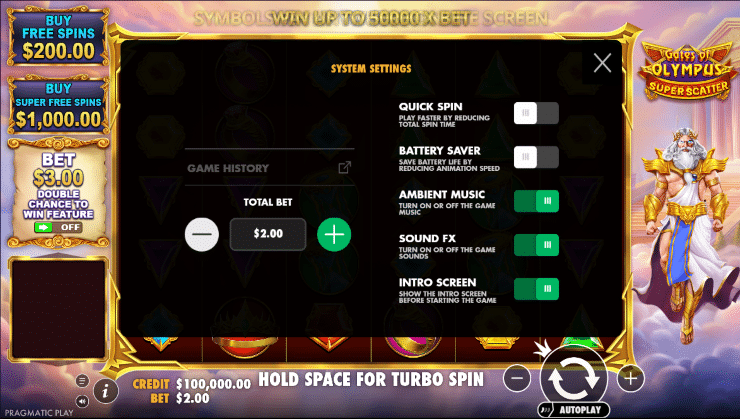
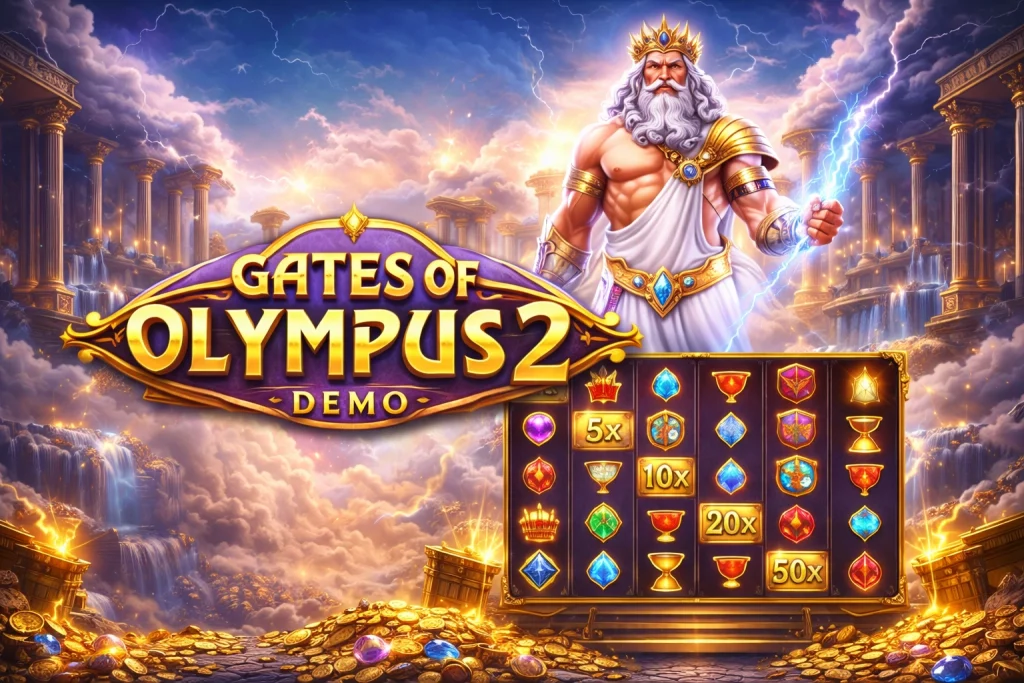
Play Gates of Olympus 2 Demo
Gates of Olympus 2 Demo — Play in a Controlled Environment
Gates of Olympus 2 Demo provides access to the full mathematical structure of the game without financial exposure. The demo version mirrors the real-money environment in terms of mechanics, RTP model and volatility profile, but operates using virtual credits.
This section focuses strictly on the product environment — not promotion, not incentives, and not outcome expectations.
Demo Environment Overview
The demo mode allows players to:
- Interact with the 6×5 grid layout
- Observe tumble mechanics
- Experience multiplier accumulation
- Trigger Free Spins
- Test session pacing
All core mechanics remain active. The only difference is the balance type.
The demo balance is virtual. It does not represent withdrawable funds and cannot be converted into real money.
RNG Integrity & Mathematical Model
The demo version uses the same Random Number Generator logic as the real-money version. This means:
- Symbol distribution follows the same probability matrix
- Multiplier behavior is identical
- Scatter frequency remains consistent
- Volatility profile does not change
The demo environment does not adjust hit frequency or payout behavior. It reflects the same long-term theoretical structure.
It is important to distinguish between:
- Theoretical RTP (long-term model)
- Short demo sessions (small sample behavior)
Short sessions may feel stable or unstable depending on distribution variance. This does not indicate changes in the algorithm.
Grid Structure Preview
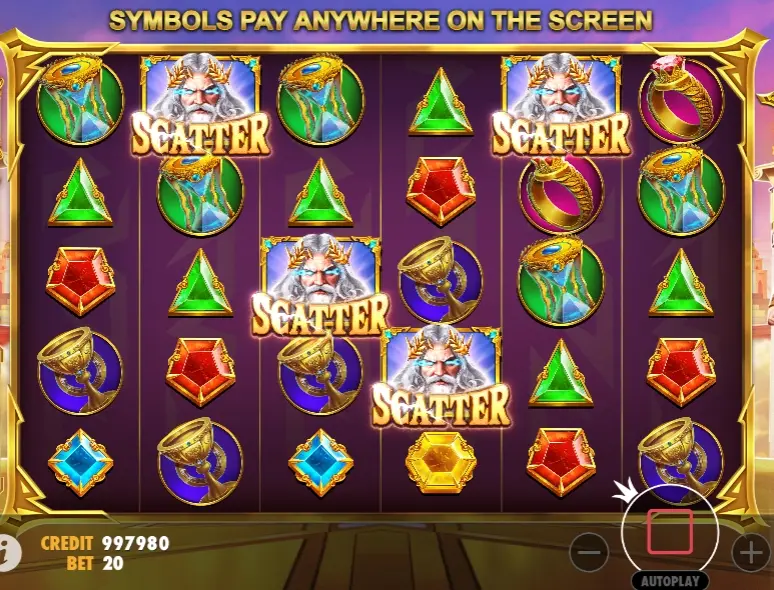
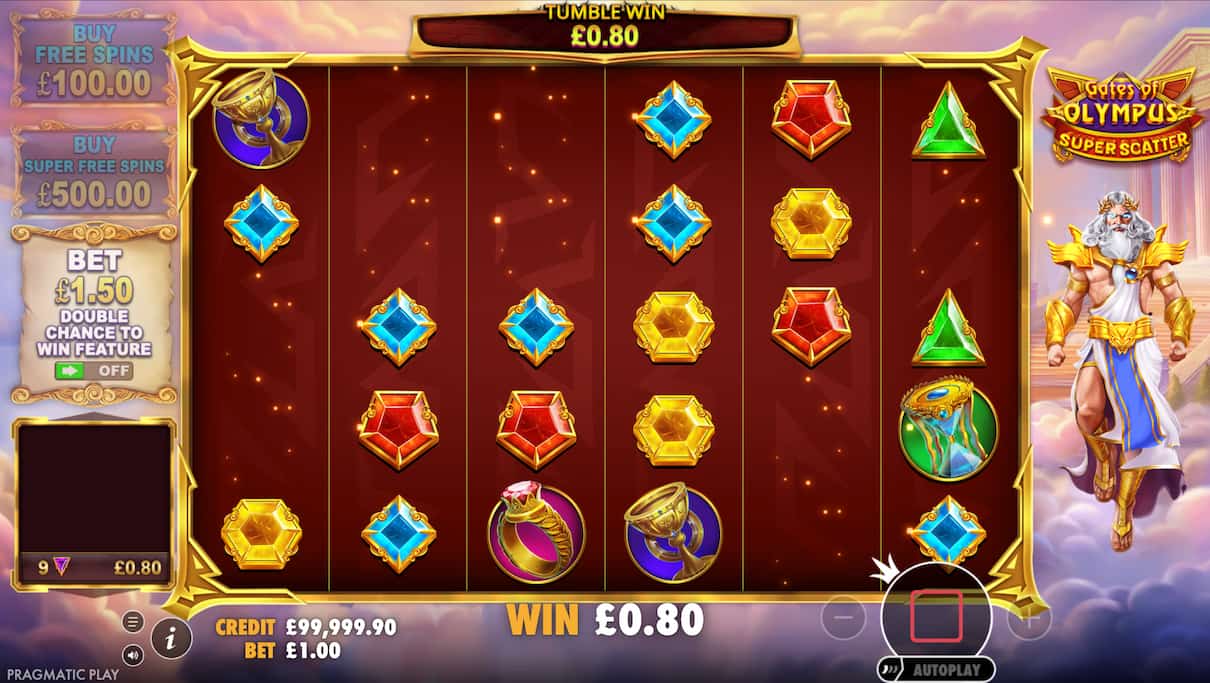
Gates of Olympus 2 operates on a 6×5 grid without traditional paylines.
Wins occur when:
- 8 or more matching symbols land anywhere on the grid
- Winning symbols disappear
- New symbols fall (tumble mechanic)
- Multipliers accumulate within the same round
The demo allows players to observe how symbol clusters evolve across consecutive tumbles without financial pressure.
Session Flow in Demo Mode
In demo mode, players can:
- Adjust bet values freely
- Reset balance
- Pause sessions
- Experiment with pacing
Because no real funds are involved, the demo serves as a structural exploration tool.
It is not designed to simulate profitability.
It is designed to demonstrate mechanics.
Dark Glass Demo Section
Gates of Olympus 2 Demo
Experience the complete game mechanics in a virtual balance environment. Identical volatility structure, multiplier behavior and tumble logic.
Game Mechanics & Structure
Core Layout: 6×5 Grid, Cluster Wins, No Paylines
Gates of Olympus 2 runs on a 6×5 grid with a cluster-based win system. Instead of fixed paylines, wins occur when a minimum number of matching symbols land anywhere on the grid at the same time.
In practical terms, this changes how a spin “feels”:
- Wins are not constrained by line patterns
- Clusters can form across the full grid
- Outcomes are driven by symbol density rather than alignment
This is why the tumble system matters: the grid is not static. It resets locally after wins and keeps evolving inside a single spin cycle.
Tumble Mechanic: Why One Spin Can Contain Multiple Outcomes
After a winning cluster forms:
- Winning symbols are removed
- New symbols fall into the grid
- The grid is evaluated again
- The cycle repeats until no new win occurs
This mechanic doesn’t “increase RTP” on its own — it changes the structure of how outcomes can chain inside the same base spin. It also affects session rhythm: some spins resolve quickly, others become longer chains.
Multiplier Symbols: Stacking Logic Within a Spin
A key mechanic is the multiplier symbol system:
- Multipliers can land during tumbles
- They can stack within the same spin sequence
- The final multiplier applies to the total win produced in that sequence (not to future spins)
This is important for demo use: you can observe how multipliers behave without confusing short-term variance for a stable pattern.
Multipliers do not “carry momentum” between spins. They are bounded by the current spin chain.
Scatter & Free Spins Structure
The game uses a scatter-triggered bonus structure:
- A specific number of scatters triggers Free Spins
- Free Spins follow the same grid and tumble logic
- Multipliers remain part of the feature environment, but still operate within the same chain logic (they stack inside sequences)
In demo mode, you can explore how frequently Free Spins occur in a short session without treating that frequency as a fixed expectation.
What Demo Mode Helps You Learn Here
Demo mode is especially useful for mechanics-heavy games because you can isolate:
- How often tumble chains occur
- How multiplier stacking behaves inside chains
- How bonus triggers appear across short sessions
- How quickly the grid resolves (spin length variability)
It’s not a tool for predicting results — it’s a tool for understanding structure.
Multiplier Flow Model
Symbol & Feature Structure
Symbol & Feature Structure
| Component | Role | Trigger / Condition | What to observe in demo |
|---|
RTP & Volatility Profile
Theoretical RTP Model
Gates of Olympus 2 operates under a fixed theoretical Return to Player model. RTP represents the expected long-term payout percentage calculated over millions of simulated spins.
This value:
- Is statistical
- Applies only over extended cycles
- Does not predict short sessions
- Does not guarantee outcomes
In demo mode, RTP behaves identically to the real-money version. The mathematical engine remains unchanged.
High Volatility Explained
The game is categorized as high volatility.
This means:
- Wins may be less frequent
- Outcome distribution is wider
- Larger multiplier chains are possible but not predictable
- Session balance may fluctuate significantly
Volatility affects distribution shape, not fairness.
Short-Term Reality vs Long-Term Model
In short demo sessions:
- Variance can appear elevated
- Free Spins may trigger early or late
- Multiplier stacking may seem clustered
This does not indicate pattern behavior. It reflects natural distribution variance.
High volatility games require longer sample sizes before the statistical model stabilizes.
Why Demo Is Useful for Volatility Observation
Demo mode allows players to:
- Observe frequency rhythm
- Experience chain variability
- Understand how multiplier stacks form
- Recognize that not every spin builds into extended tumbles
The goal is structural understanding — not expectation shaping.
Volatility Distribution Curve
This chart visualizes distribution behavior in a high volatility slot.
It shows:
- Base frequency zone
- Extended chain zone
- High multiplier spike zone
It does not show wins.
It shows distribution density.
Technical Snapshot
Technical Snapshot
| Parameter | Value | Structural Meaning |
|---|---|---|
| RTP Model | Theoretical (long-term) | Applies across extended cycles, not short sessions. |
| Volatility | High | Wide distribution, lower frequency, higher variance. |
| Hit Frequency | Variable | Cluster-based system affects perceived frequency. |
| Multiplier Mechanic | Stacking per sequence | Applies only within a tumble chain. |
| Feature Trigger | Scatter-based | Free Spins activation dependent on scatter count. |
Demo vs Real Play Environment
Demo credits vs real balance
The demo version of Gates of Olympus 2 is built for exploration. It uses virtual credits and removes financial exposure, but it does not simplify the game logic.
In other words:
- Demo changes the balance type
- It does not change the mechanics
- It does not change volatility
- It does not change the theoretical RTP model
This distinction matters because many players interpret a short demo run as “proof” of how the game behaves. In high volatility slots, short sessions can vary widely. A demo session can look calm or spiky depending purely on distribution variance.
What stays identical
Across demo and real play, the following structural elements remain the same:
- 6×5 grid layout
- Cluster win requirements
- Tumble chain logic
- Multiplier symbol behavior (stacking within a sequence)
- Scatter-based feature trigger structure
- Volatility classification and distribution shape
The RNG logic does not “adapt” to demo.
Each spin remains independent.
What changes in practice
The differences between demo and real play are environment-level:
- balance is virtual
- there is no withdrawal
- the psychological pressure is lower
- session pacing may feel faster (people click quicker in demo)
That last point is important: players often take more spins per minute in demo mode. Faster pacing increases the number of decisions and amplifies the perception of variance.
The game does not change — the session behavior changes.
Using demo for the right purpose
A demo is most useful when you want to learn:
- how tumble chains feel
- how multipliers appear and stack
- how often a spin resolves in one step vs multiple tumbles
- what the Free Spins structure looks like
A demo is not a reliable tool for predicting what happens in short real-money sessions.
Demo vs Real
Demo vs Real Play — Environment Comparison
| Feature | Demo | Real Play | Notes |
|---|
Responsible Demo Usage & Session Control
Demo as a Structural Tool, Not a Forecast Tool
Gates of Olympus 2 Demo should be approached as a structural learning environment. The purpose of demo mode is to understand how the game behaves mechanically — not to estimate future outcomes.
Because the slot operates with high volatility, short demo sessions can feel:
- unusually calm
- unusually spiky
- clustered in multiplier behavior
- quiet in feature triggers
None of these impressions represent predictive information. They reflect distribution variance inside a small sample size.
The longer the observation period, the closer the model aligns with theoretical structure.
Understanding Session Rhythm
Session rhythm in Gates of Olympus 2 is shaped by:
- tumble frequency
- chain length
- multiplier stacking
- feature entry timing
In demo mode, players often increase spin speed. Faster sessions amplify perception of volatility because more outcomes are observed in a shorter period.
Slowing down demo sessions can provide a clearer view of:
- how often tumbles extend beyond one cascade
- how multipliers accumulate within a chain
- how frequently Free Spins appear relative to total spins
Volatility does not change — pacing changes perception.
Multiplier Observation Strategy
One of the key structural aspects of this game is multiplier stacking inside a single spin sequence.
In demo mode, it is useful to observe:
- whether multipliers land early or late in a chain
- how frequently they stack beyond one level
- how often chains end before multiplier escalation
What matters structurally:
- multipliers reset after the spin
- they do not persist
- they do not “warm up” the game
Each spin remains independent.
Feature Trigger Variability
Free Spins are scatter-based. In short sessions, feature triggers may:
- appear quickly
- appear rarely
- cluster
- space out significantly
This variability is consistent with high volatility classification.
Demo mode allows you to see the feature environment without financial impact, but it does not smooth distribution.
Psychological Difference: Demo vs Real Play
While the mathematical structure remains constant, player behavior differs between demo and real environments.
Common behavioral differences include:
- higher spin speed
- lower emotional weight per spin
- experimentation with bet levels
- quicker session transitions
These factors affect perception of stability.
The game engine does not adjust volatility between demo and real play.
The difference lies in the human interaction layer.
Session Control Principles
Even in demo mode, structured session control is useful:
- Set a time boundary
- Avoid interpreting short streaks as patterns
- Separate volatility observation from expectation
- Evaluate mechanics rather than outcomes
Demo mode is best used as a technical preview.
Structural Summary
Gates of Olympus 2 Demo provides:
- Full grid mechanics
- Complete tumble system
- Multiplier stacking logic
- Identical volatility profile
- Identical theoretical RTP structure
It does not provide:
- Financial exposure
- Predictive insight
- Outcome guarantees
The purpose of demo mode is clarity — not projection.